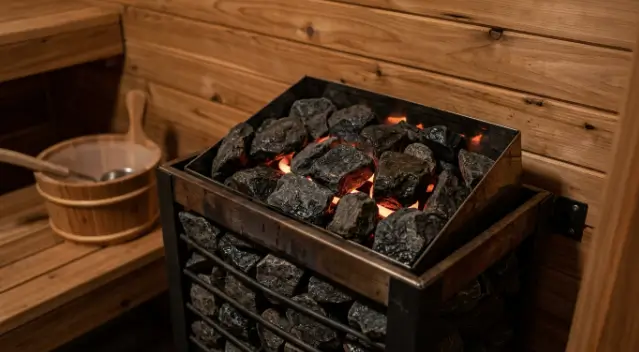
Keeping an electric sauna heater running well for a decade or more comes down to three routine habits: restacking or replacing the rocks every few months, keeping the heating elements and vents free of dust and debris, and never letting water pool directly on a cold heater. Owners who stick to that routine typically get 8 to 15 years out of a quality unit. Owners who ignore it often see cracked rocks, uneven heat, or a failed element inside three to five years.
DIY Rock Care Versus Letting Them Go
Rocks take the brunt of the thermal stress in any electric heater, since they get poured on with water and then heat right back up, over and over, and that cycle eventually cracks even good stone. Owners who check the rock bed every three to four months and pull anything cracked, chipped, or coated in a white mineral film keep heat distributing evenly across the whole load. Owners who never touch the rocks after the initial fill tend to end up with a bed full of shattered fragments that block airflow between the heating elements, which forces the heater to work harder for a weaker steam result and shortens the life of the elements underneath. A full restack once a year, pulling every rock, rinsing the bed, and resetting it with the largest stones on the bottom, is the single highest-value maintenance task on the list and it costs nothing but twenty minutes.
Which Rock Type Holds Up Best?
Not every stone sold as “sauna rock” performs the same. Dense volcanic rock like olivine diabase or peridotite handles repeated heat cycling far better than soft, porous stone or ordinary landscaping rock, which can pop or split within weeks under a hot electric element. Buying rocks rated specifically for sauna use, rather than substituting river rock from a hardware store, is one of those small decisions that pays off across the life of the heater. A typical residential electric heater holds somewhere between 40 and 90 pounds of rock depending on its kilowatt rating, and that whole load is worth replacing, not just topping off, during the annual restack.
Routine Cleaning Versus Skipping It
The heater housing and the room around it collect dust, lint, and hair over time, and that buildup restricts airflow to the elements and, in enough volume, becomes a fire hazard once the unit heats up. Wiping the exterior housing down between sessions and keeping the floor around the heater clear takes a few minutes a month. Skipping it long enough lets debris settle into the guard rail and vents, which can scorch and produce a burning smell the next time the heater runs hot, a smell that is often mistaken for an electrical fault when it is really just months of dust finally cooking off.
Professional Service Versus DIY
Most maintenance on an electric heater, rock swaps, exterior cleaning, checking that the guard rail is still secure, is well within reach for a homeowner with no special tools. The line to draw is around anything involving the heating elements, the contactor, or the wiring behind the control panel. Opening that housing on a unit still under warranty can void the coverage outright, and working on 240-volt wiring without the right training is a genuine safety risk, not just a warranty technicality. If a heater is tripping its breaker, running noticeably cooler than it used to, or making an electrical smell that is not just dust, that is a job for a licensed electrician or the manufacturer’s service line rather than a weekend project.
Regular Inspection Versus Waiting for a Problem
A quick visual check every month catches most issues before they become expensive. Look at the guard rail for loose mounting screws, since a rail that has worked loose under repeated heat cycling is both a burn risk and a sign the surrounding wood has started to shift. Check that the control panel responds normally and that the heater reaches its set temperature within the expected window, since a unit that suddenly takes noticeably longer to heat up is often flagging a failing element well before it stops working entirely. Owners who wait until the heater fails outright to investigate usually discover the problem has been building for months, sometimes long enough that a cracked element has also damaged a section of the rock bed sitting directly above it. A five-minute monthly check, done at the same time as a rock inspection, is enough to catch nearly all of this early.
Buying Replacement Parts
Heating elements, rocks, and guard rails are usually sold as standalone replacement parts rather than requiring a whole new heater, which is one of the better arguments for buying from an established maker in the first place instead of a no-name import unit with no parts pipeline. Checking what one specialty retailer stocks in the way of elements and rock kits for a specific model, before a failure happens, saves a scramble later when the heater is down and the household wants it working again by the weekend. A heater with a known, in-stock parts list is a materially different ownership experience than one where a failed element means replacing the entire unit.
What the Research Says About the Payoff
The upkeep is worth it because regular sauna use carries genuine, if modest, associations with better long-term health outcomes. A 2023 review in Mayo Clinic Proceedings summarized how regular Finnish-style sauna bathing correlates with favorable cardiovascular markers, particularly when combined with other healthy habits like regular exercise. A related paper in the American Journal of Physiology examined the body’s physiological response to heat exposure more broadly, including how repeated sauna sessions affect vascular function over time. Earlier work in Mayo Clinic Proceedings found associations between frequent sauna use and lower rates of fatal cardiovascular events in a large Finnish cohort. These remain population-level associations rather than guarantees for any individual, and none of it substitutes for a heater that is actually maintained well enough to keep running.
Frequently Asked Questions
How often should sauna rocks be replaced? Check every three to four months and pull any that are cracked or coated in mineral buildup. Do a full restack once a year regardless of how the rocks look.
How long does an electric sauna heater last? Typically 8 to 15 years with regular maintenance. Heating elements can often be replaced individually rather than swapping the whole unit.
Do you need to clean an electric sauna heater? Yes. Wipe down the exterior housing periodically and keep the surrounding floor clear of debris that restricts airflow to the elements.
Should you hire a professional for sauna heater maintenance? Rock swaps and cleaning are fine for most owners to handle. Anything touching the elements, contactor, or wiring should go to a licensed electrician.
References
- Does the Combination of Finnish Sauna Bathing and Other Lifestyle Factors Confer Additional Health Benefits? A Review of the Evidence, Mayo Clinic Proceedings, 2023
- Effects of heat and cold on health, with special reference to Finnish sauna bathing, American Journal of Physiology – Regulatory, Integrative and Comparative Physiology, 2018
- Cardiovascular and Other Health Benefits of Sauna Bathing: A Review of the Evidence, Mayo Clinic Proceedings, 2018
By Carla Jensen