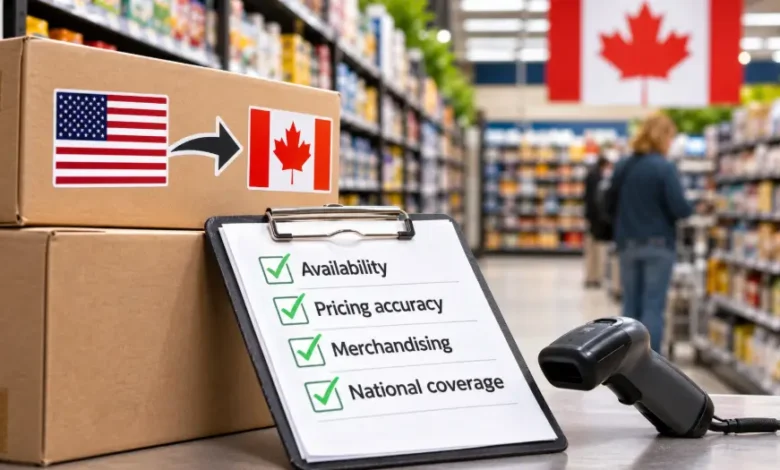
For American consumer packaged goods (CPG) manufacturers looking to expand internationally, Canada often appears to be the most logical first market. The countries share an extensive border, established trade relationships, similar consumer lifestyles and many recognizable retail brands. A product that performs well in American supermarkets, pharmacies or mass merchandise stores may seem well positioned for success with Canadian consumers.
Yet the similarities between the two markets can create a false sense of simplicity. Canadian retail operates within a different competitive, regulatory and geographic environment, and manufacturers that underestimate these differences can encounter unexpected challenges after securing their first distribution agreements. Products may require different packaging, retail buyers may have distinct assortment expectations, and maintaining consistent merchandising execution across Canadian stores can be more complicated than anticipated.
The challenge is particularly significant for mid-sized American manufacturers that have developed successful domestic distribution but lack dedicated Canadian operations. These companies may have strong products, established marketing programs and experienced U.S. sales teams, yet still struggle to translate their existing retail processes into the Canadian market.
For brands planning cross-border expansion, the most important question is not simply whether Canadian consumers will purchase their products. It is whether the company has the operational infrastructure to support those products once they enter Canadian stores.
Canada is a different retail market, not simply another U.S. region
American manufacturers are accustomed to operating across large geographic territories, but Canada’s retail structure introduces different considerations. A relatively concentrated grocery market, substantial distances between population centres and distinct regional consumer preferences influence how manufacturers approach distribution and retail execution.
Major grocery organizations such as Loblaw, Sobeys and Metro operate extensive networks of stores under multiple banners, while Walmart Canada and Costco also play important roles in the market. These retailers serve different customer segments, and their merchandising requirements can vary according to store format, category and location.
For American brands, obtaining a listing with a Canadian retailer is an important commercial achievement, but it does not guarantee uniform execution across the retailer’s network. Individual locations may have different assortments, shelf configurations and promotional requirements, making it necessary to understand how distribution agreements translate into store-level operations.
A manufacturer accustomed to working with a particular U.S. retail banner should not assume that the same processes apply to its Canadian operations. Even when the retailer’s name is familiar, local purchasing structures, distribution arrangements and merchandising procedures may differ.
These distinctions become especially important during the early stages of market entry, when manufacturers need reliable information about how products are being received and presented.
Packaging and regulatory requirements demand early attention
One of the first challenges American CPG manufacturers encounter involves Canadian packaging and labelling requirements. Depending on the product category, manufacturers may need to modify packaging, nutritional information, ingredient declarations or other consumer-facing materials before selling products in Canada.
For many prepackaged consumer products, Canadian regulations require mandatory information to appear in both English and French, subject to applicable exceptions. Food manufacturers must also consider requirements administered by the Canadian Food Inspection Agency and Health Canada.
Canada’s front-of-package nutrition labelling rules introduced another consideration for qualifying food products beginning January 1, 2026. Products meeting specified thresholds for saturated fat, sugars or sodium must display standardized nutrition symbols unless an exemption applies.
These requirements can affect packaging design, production schedules and inventory planning. Manufacturers cannot necessarily use their existing American packaging without reviewing its compliance with Canadian regulations.
For companies introducing multiple products, the operational implications can be substantial. Packaging modifications may require separate inventory, updated product photography, revised retailer information and coordination with distributors.
The importance of these preparations extends into merchandising because store-level execution depends on products arriving with the correct packaging and information.
A manufacturer that secures retail distribution before completing the necessary regulatory and operational preparations may experience delays that affect product launches and promotional commitments.
The Canadian retail shelf creates a different competitive environment
Canadian consumers have access to many of the same international brands found in American stores, but the competitive environment also includes established Canadian manufacturers, regional products and retailer-owned brands.
An American company entering the market must therefore evaluate how its products compare with alternatives already familiar to Canadian shoppers.
A premium snack brand that performs well in the United States may encounter different pricing expectations in Canada because of currency conversion, transportation costs, distribution arrangements and retailer margins. These factors can influence the final shelf price and the product’s perceived value relative to competitors.
Manufacturers should also consider whether their existing brand positioning translates effectively to Canadian consumers. Product claims, promotional messages and packaging that resonate in one market may require adjustment in another.
This does not mean American brands must abandon successful marketing strategies. Rather, they need to understand how those strategies operate within the Canadian retail environment.
The physical presentation of merchandise plays an important role in this process. Products must be positioned within appropriate categories, displayed consistently and supported by accurate pricing information.
For premium manufacturers, these details contribute to whether consumers recognize the product’s intended value.
Why merchandising support should be established before expansion
American manufacturers frequently devote considerable attention to negotiating distribution agreements, arranging logistics and preparing marketing campaigns. Merchandising execution can receive less attention until products have already reached stores.
This sequencing can create problems because the operational requirements of retail distribution begin as soon as products arrive.
Working with a premium merchandising company can help manufacturers establish processes for monitoring product availability, verifying shelf placement and identifying merchandising inconsistencies across participating retail locations.
For companies without Canadian field teams, external merchandising support may provide a practical way to maintain visibility into store conditions without immediately building a permanent local workforce.
This becomes particularly valuable when a manufacturer launches across several retail banners simultaneously. Different store formats and promotional schedules can make execution difficult to coordinate through a small internal sales team.
Store-level reporting can help identify whether products are available, whether displays comply with agreed arrangements and whether promotional materials have been installed correctly.
These observations provide operational context that sales reports alone may not reveal.
A product experiencing disappointing sales may have weak consumer demand, but it may also be difficult to locate, incorrectly displayed or unavailable during important promotional periods.
Understanding the difference can influence how manufacturers allocate resources during their first months in the Canadian market.
Ontario is often a logical starting point for market entry
Ontario’s large population and extensive retail infrastructure make it an important market for American manufacturers evaluating Canadian expansion.
The Greater Toronto Area offers access to diverse consumer segments, major retail banners and distribution infrastructure. However, Ontario should not be treated as a uniform market.
Shopping behaviour and store formats can differ between downtown Toronto, suburban communities, regional cities and smaller towns. Retailers may also operate different banners serving distinct customer groups.
A product that performs well in a premium urban supermarket may require different promotional support when introduced into a conventional grocery store or discount environment.
For manufacturers establishing an initial presence in the province, working with a premium merchandising company in Ontario can support store-level oversight while the business develops a better understanding of local retail conditions.
This approach allows companies to assess execution across different locations rather than relying exclusively on aggregate sales results.
Ontario can also provide valuable operational lessons before manufacturers expand into additional provinces, particularly when those lessons involve replenishment processes, merchandising requirements and retailer communication.
However, success in Ontario does not automatically establish readiness for national distribution. Expansion into Quebec, Western Canada and Atlantic Canada introduces additional regional considerations that manufacturers need to evaluate independently.
National coverage involves more than having representatives in major cities
One of the challenges American manufacturers may underestimate is the operational complexity of maintaining consistent merchandising standards across Canada’s geographic territory.
The country’s population is concentrated in particular metropolitan regions, but retail networks extend into smaller cities and communities that may require different travel arrangements and service schedules.
A merchandising program that covers Toronto, Montreal and Vancouver may still leave important gaps in regional markets.
Manufacturers considering national expansion should therefore examine the geographic capabilities of potential merchandising partners, including how field visits are scheduled, how regional teams are coordinated and how reporting standards are maintained.
Coverage should be evaluated against the manufacturer’s actual retail footprint rather than a general claim of national service.
For example, a brand distributed primarily through grocery and pharmacy locations may require a different field support structure from a manufacturer selling through specialty retailers or warehouse clubs.
Service frequency also matters. Some products may require regular replenishment checks, while others may need support during promotional periods, new product launches or seasonal transitions.
The objective is to establish a merchandising program that reflects the manufacturer’s distribution and commercial priorities.
Technology is changing expectations for merchandising partners
Modern retail merchandising increasingly involves digital reporting, photographic documentation, mobile field applications and data analysis.
These capabilities can provide manufacturers with greater visibility into store conditions, particularly when internal management teams operate outside Canada.
A U.S. manufacturer may need to understand whether products are correctly displayed across Ontario stores without sending employees to inspect each location personally.
Digital field reports can provide photographs, observations and records of merchandising activities that help management evaluate execution remotely.
More advanced systems may also support issue tracking, standardized reporting and comparisons between retail locations.
Artificial intelligence and computer vision are creating additional possibilities for analyzing shelf photographs, identifying potential compliance problems and organizing large volumes of field information.
However, technology should not be evaluated independently of operational capability.
A merchandising provider may offer sophisticated reporting software, but the value of that technology depends on whether employees collect accurate information and whether identified problems are addressed.
Manufacturers should therefore evaluate both the technical infrastructure and the practical experience of prospective merchandising partners.
The importance of a skilled local team
Technology can improve reporting and coordination, but retail merchandising remains dependent on people who understand store operations and can work effectively with retail personnel.
Field representatives need to recognize merchandising deficiencies, follow retailer procedures and communicate problems appropriately.
They must also understand that the same issue can require different responses depending on the store, retailer and product category.
An unavailable product may require replenishment, but it could also reflect an assortment change, distribution delay or inventory discrepancy.
Experienced representatives can help distinguish between these situations and document the information needed for corrective action.
For American manufacturers, local knowledge can be especially valuable during market entry because internal teams may be unfamiliar with Canadian retail practices.
A skilled merchandising partner should be able to explain how field activities are managed, how representatives are trained and how quality is monitored.
Manufacturers should also understand whether the provider has experience with their specific product categories and retail channels.
A company specializing in grocery merchandising may have different capabilities from one focused primarily on pharmacy, electronics or general merchandise.
Selecting a partner should therefore involve evaluating relevant experience rather than relying exclusively on geographic coverage or pricing.
Measuring the success of Canadian market entry
Manufacturers entering Canada naturally focus on distribution growth and sales performance, but these measures do not provide a complete understanding of whether the expansion is progressing effectively.
A product may secure listings across numerous stores while experiencing inconsistent availability or weak promotional execution.
Without additional information, management may struggle to determine whether disappointing sales reflect consumer preferences or operational problems.
Merchandising performance measures can help provide that context.
On-shelf availability, planogram compliance, promotional execution and recurring merchandising deficiencies can all contribute to a clearer understanding of retail conditions.
Manufacturers should also evaluate how quickly identified problems are communicated and whether corrective actions are completed.
These measures are particularly valuable during the early stages of market entry, when companies are still developing their understanding of Canadian retailer expectations.
Combining merchandising information with sales results can help identify opportunities to improve execution before committing additional resources to distribution expansion or advertising.
Building a sustainable Canadian retail presence
For American CPG manufacturers, Canada offers meaningful opportunities for international growth, but success requires more than extending an existing U.S. sales strategy across the border.
Companies need to account for regulatory requirements, retailer relationships, geographic differences and the practical demands of maintaining products across physical stores.
They must also recognize that retail distribution and retail performance are not the same thing.
Securing shelf space creates an opportunity to reach consumers, but consistent merchandising execution helps determine whether that opportunity becomes sustainable commercial growth.
Manufacturers that establish reliable local support, invest in appropriate technology and maintain visibility into store-level conditions may be better positioned to identify problems early and protect their retail investments.
The most effective expansion strategies will combine strong products and marketing with operational processes designed specifically for the Canadian market.
For American brands considering their next stage of growth, Canada should be approached as a distinct retail environment with its own requirements and opportunities. The companies that recognize these differences before entering the market will be better prepared to build lasting relationships with Canadian retailers and consumers.